
How to Find a Prince George Property Owner
Start with the address. Prince George County's public lookup, Vision, accepts an address, an owner name, a parcel number, or a PID. An address search returns the assessor's owner field, the legal description, and the parcel identifier in one place. That card is the first solid answer. Take the parcel number next to Virginia SRA or the Circuit Court Clerk and pull the most recent deed, which names the grantee of record. Keep the limits in mind, though. This method surfaces the name the county records show. It says nothing about who occupies the property, and it settles no title dispute.
- Search the situs address in Vision and note the owner name, parcel ID and legal description.
- Find the newest recorded deed by the parties or instrument reference and compare the grantee with the assessor.
- If the grantee is an LLC or corporation, check the Virginia State Corporation Commission's entity record; the exact search URL was not captured in the research.
- Use the listed mailing address only for a lawful property matter, and confirm that it belongs to the same parcel.
Prince George Property Owner Record Sources
Two offices carry the weight here. Vision, the county's public property-information system, draws on a CAMA database. The county describes it as a mirror of ownership maintained in recorded documents. The Circuit Clerk holds the other half. A deed filed there is the legal instrument that actually transfers the land. The GIS map helps confirm which parcel is under discussion. You can commit to a record after that. Business-entity records add a wrinkle of their own. A registered agent's name may surface. That filing never replaces the deed naming the entity as grantee.
| Source | Owner Info It Gives | Access |
|---|---|---|
| Vision assessor record | Owner of record and mailing/location fields described in county material | Public search by address, owner, parcel number or PID |
| Circuit Clerk deed | Grantor, grantee, recording date and legal description | Virginia SRA where enabled or Clerk counter |
| County GIS | Parcel shape and location context | Online map link; selected record fields not confirmed |
| Virginia SCC entity record | Company name, status and registered agent | State search URL and field list not captured |
The owner of record is simply the party named in the county's ownership field or the latest deed. That is its whole meaning. It is not a roster of residents. The assessor card may list a mailing address tied to a different home or an office across the state, so read the two fields as separate facts. A mailing address never proves occupancy.
Limits on Who Owns a Prince George Property
A Prince George owner lookup has clear edges. It can name the parties in public property records. It cannot tell you who stands inside a house, and it cannot promise a transfer is free of every claim. Some gaps are practical. The assessor publishes no visible card labels or update timing in public text, and the exact SRA index cutoff and image access rules call for confirmation at the Clerk's counter. Cite your source and its date whenever you give a record-based answer about a parcel. For a true title conclusion, compare the assessor entry against the newest recorded deed, then ask the Clerk or a title professional about any gap between them.
Lawful use. Use public owner information for property research, purchase diligence and civic review. Do not use it to stalk, threaten or harm another person.
Prince George Mailing and Situs Addresses
Situs and mailing addresses answer different questions. Situs marks the land's physical location. Mailing address marks where assessment and tax notices go. One owner holding several parcels may route every notice to a single mailing address. A company may receive bills through an office or agent. When checking who owns a Prince George property, match the card's address to the mapped parcel and legal description. Do that before treating the owner's name as final. A mailing address outside the county is not proof of an error by itself. Nor is a street name that differs. Ask the Assessor how the situs and mailing fields are stored. Ask the Treasurer where bills are sent when the question involves a payment or notice.
The assessor's own material treats property location and ownership as separate card information. Once the parcel match is sound, the mailing field works. It serves contact tied to the land. Read it with care. A tax bill may go to an owner who holds many lots. A trust or corporation may use an office address instead. The record shows where notices travel. It never establishes that the listed owner lives there. Nor does it prove that someone else deserves a copy.
Entity and Estate Property Owners in Prince George
A grantee on a Prince George deed can be an individual, an LLC, or a corporation. It can also be a trust, a trustee, an estate, or a fiduciary. Copy the legal name exactly as the deed records it. Punctuation and suffixes matter. A search under a trade name will often miss the indexed party entirely. For entity details, Virginia's State Corporation Commission is the state source. It covers entity name, status, registered agent, and filings. The deed names the grantee; an agent or beneficiary is a separate role. An SCC record can identify an entity. It does not prove that the entity owns a given parcel.
Death can move land through probate as well as the deed index. The Circuit Clerk links probate and handles estate papers. When an assessor card still names a decedent, search the estate or fiduciary papers first. Then check later deeds recorded under the personal representative and heirs. This explains a change in names without assuming the tax roll has already caught up.
A common surname may return too many hits. Try a legal entity name, a fiduciary name, or a spelling variant. Use the parcel description to confirm the match. Virginia FOIA lets you request an existing public record with reasonable specificity. It does not make the county perform a title analysis. It also does not require building a new owner list. Ask for the deed, card, or map record that supports your question.
Why a Prince George Property Owner Field Can Lag
The FY2024 assessor report says the CAMA system is intended to mirror ownership. That ownership is maintained in Clerk records. Deeds, vacations, easements, rights-of-way, boundary adjustments, splits, combinations, leaseholds, rezonings, and special-use permits all count as processed property changes. The assessor card is therefore a mirror of a legal filing, not the filing itself. A recently recorded deed can appear before the assessor's data is refreshed. A split can create a new parcel record altogether.
Timing differs across sources. The assessor's public page describes reassessment as biennial. The FY2024 report, meanwhile, covers annual January 1 valuation. It also notes a July 1 Land Book effective date. Vision advertises a January 1, 2027 reassessment process. These dates relate to different steps. So preserve whichever date displays with the record you are viewing.
Carry a Prince George PID Across Offices
Vision advertises Parcel Number searches. It also covers PID searches, and VADeed Alert accepts a Tax Map or Parcel ID watch. That makes the identifier a useful bridge from an assessor card to a land-record question. County GIS products also include tax-parcel shapes and address points. Use the full identifier as displayed. Keep any prior number if a split or combination has altered the parcel.
A map helps locate the parcel, but the deed names the legal interest. For a present-tense review of the owner field, see current Prince George owner records. For earlier grantees, use the former-owner deed chain. Every step should refer to the same legal description or document reference.
VADeed Alert for Prince George Property Owners
The Clerk's VADeed Alert link offers free email notices. These arrive whenever a name, business name, or Tax Map or Parcel ID matches a recorded document. An alert can prompt a review of a new filing. That is useful once the assessor card and deed records have been matched. It cannot stop a transfer. It cannot judge whether a document is valid. Open the instrument and confirm it with the Clerk if a notice is unfamiliar. The VADeed Alert sign-in is the official state enrollment route linked by the county Clerk.
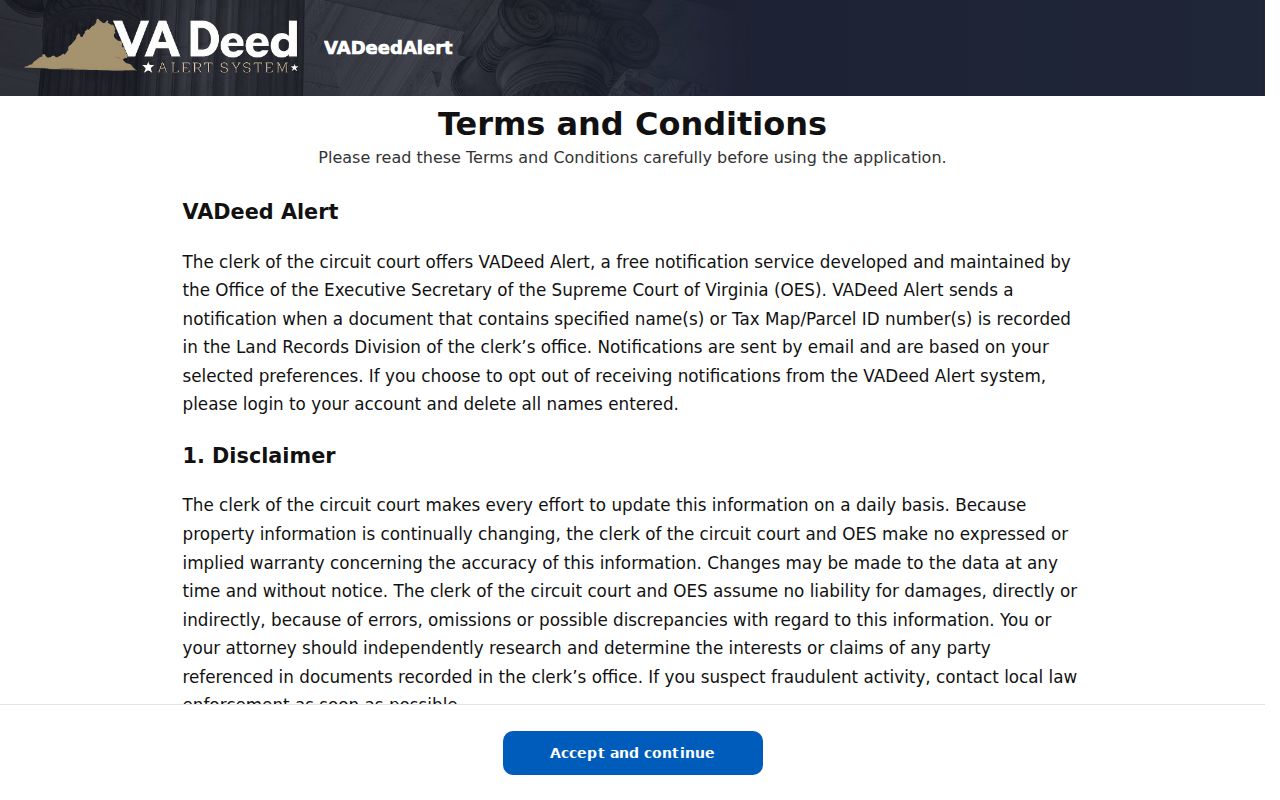
Note: Treat an alert as notice of a matching record, then verify the actual instrument and parcel before reacting.