
Prince George Deed Records and Instruments
Prince George's Circuit Court Clerk serves as the local recorder. It handles land transfers, financing statements, judgment liens, and probate and estate papers. The land records include deeds, deeds of trust, releases, easements, rights-of-way, plats and boundary agreements. A deed conveys or confirms an interest. A deed of trust or lien does something different. It records a claim against the property. The labels below describe common instrument purposes. They are not a verified list of separate filters in the local SRA form.
| Deed Type | What It Does | Common Use |
|---|---|---|
| Deed of conveyance | Records a transfer and its legal description | Confirm the present or prior grantee |
| Quitclaim deed | Transfers the grantor's stated interest without a title guarantee | Review a change between related parties |
| Deed of trust | Records a security interest tied to a loan | Search for a later satisfaction or release |
| Executor or trustee deed | Records a transfer by an estate or fiduciary | Connect probate or trust authority to title |
| Plat or boundary instrument | Sets out lots, lines or a land change | Compare the mapped parcel with its legal description |
A deed and an encumbrance are not the same thing. The deed names the parties and describes the interest conveyed. A deed of trust, judgment lien, easement or release records a separate right or claim. That claim is tied to the parcel. Reviewing a purchase means reading the deed chain and every instrument affecting it. Look for a satisfaction or release matching the original instrument. Never assume a later sale wiped out a recorded claim.
Search Grantors and Grantees in Prince George Deed Records
The best route through Prince George deed records runs backward through party names. Begin with the current owner as grantee. Find the deed by which that party acquired the property. Then read who signed as grantor, and search that name as an earlier grantee. Compare the land description closely to test whether it is the same parcel. The Virginia SRA statewide page describes the system itself. Prince George result fields, earliest online year and local image cutoff were not published on the official public pages.
- Search the known owner's name as grantee and note the recording date and instrument or book/page reference.
- Read the grantor and legal description on that instrument.
- Search the grantor as an earlier grantee, using spelling variants and entity names when needed.
- Compare acreage, road or creek calls and adjoining owners before treating an entry as the next link.
- For older books, use the Library of Virginia finding aids or request the volume from an archive or Clerk.
- Grantor
- The party who transfers or grants the stated interest.
- Grantee
- The party who receives the interest described in the deed.
- Chain of title
- The linked sequence of recorded transfers used to trace ownership back.
- Book and page
- A volume and page reference used in older records; a newer index may show an instrument number.
Get a Prince George Deed Copy
Virginia law keeps nonconfidential Clerk records open for inspection. It also allows copies for a reasonable fee. The local Clerk page publishes no full copy-price schedule beyond the state framework. Ask for the current amount before sending payment. Give the instrument number if you have it. Otherwise, include indexed parties and an approximate recording date. Add a book/page reference and the parcel's legal description. A narrow request beats asking for everything connected to a property.
The Clerk's office lists an email and mailing address for requests. Ask whether a copy can go out by mail. Or ask whether an in-person inspection is required. A Virginia FOIA request for existing public records may arrive by mail, fax, email, in person or phone. Include a reasonable description of the document sought.
Recorded, not guaranteed. The Prince George deed index shows an indexed filing, not a legal opinion on title. Ask the Clerk for a certified copy when legal proof is needed, and use a title professional to review the full chain and releases.
Prince George Clerk's Land Deed Records
The Clerk of the Circuit Court for the 6th Judicial Circuit handles Prince George land recording. The office records transfers, financing statements and judgment liens and handles probate and estate papers. Its desk sits at 6601 Courts Drive, Prince George, VA 23875, with mailing address P.O. Box 98. The phone is (804) 733-2640 and the email is dedwards@vacourts.gov. Posted weekday hours are 8:30 a.m. to 5 p.m. However, filings and financial transactions must finish before 4:15 p.m.
The Clerk's land-record page links land recordings, probate, assumed names, FAQs and VADeed Alert. For a physical deed copy or a filing, confirm the current counter procedure with the office first. The assessor and Treasurer sit on a nearby county campus. The Clerk is separately at 6601 Courts Drive.
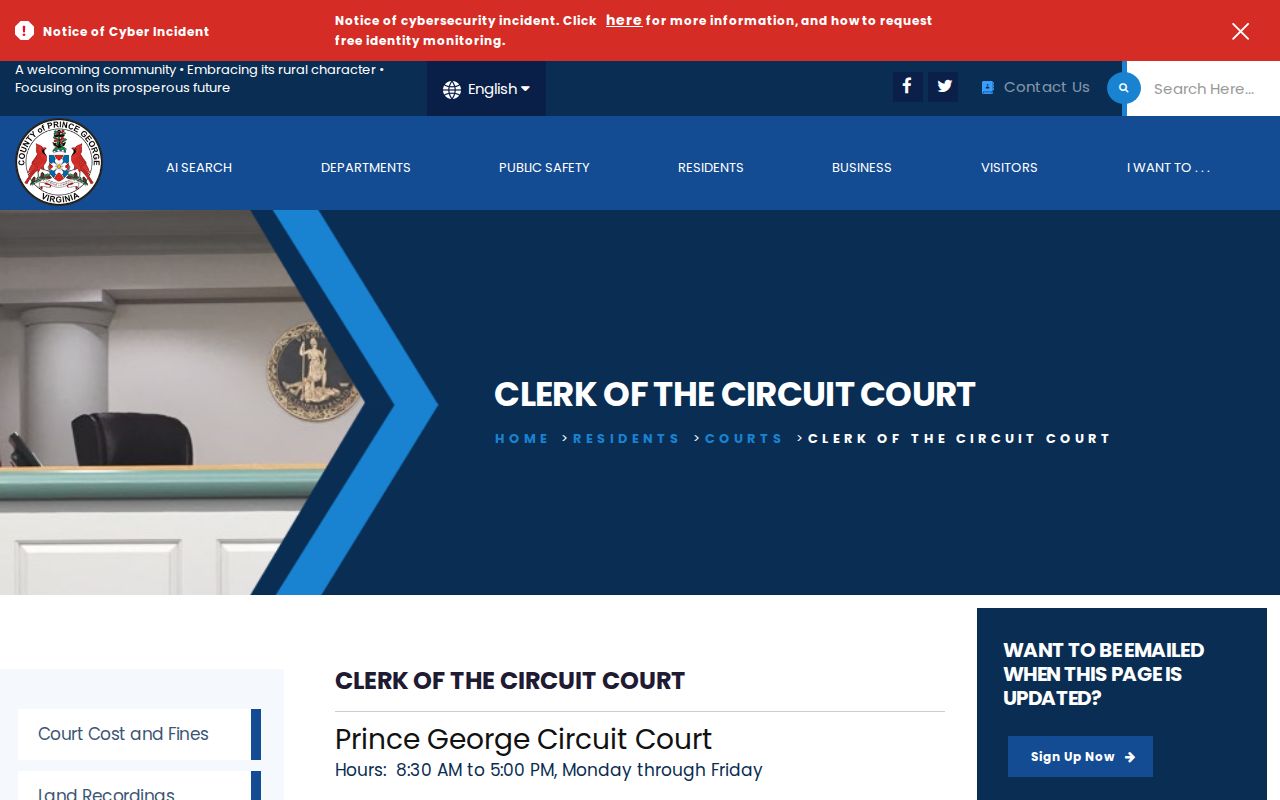
The county's official page names the local office and gathers its land-record links. Check the Clerk's current page to confirm any filing or copy request before visiting.
Virginia SRA Access for Prince George Deeds
Virginia Secure Remote Access, through COVERS, is the statewide route to land-record indexes and images. It works when an individual circuit clerk enables them. The Available Courts tab shows which clerks offer free index-only access. Images go only to subscribers authorized by the local clerk. They require a signed agreement plus payment of applicable fees. The statewide system does not promise that every Prince George instrument or image is visible remotely.
Public SRA guidance does not state a Prince George index start year, image cutoff, subscription price, result fields or pagination. If the index looks thin, ask the Clerk for help. Request an in-person search or a copy by parties, approximate recording date and legal description. In-person access remains available under Virginia law even where a remote subscriber route exists.
The statewide Virginia SRA portal explains its access terms and court availability.
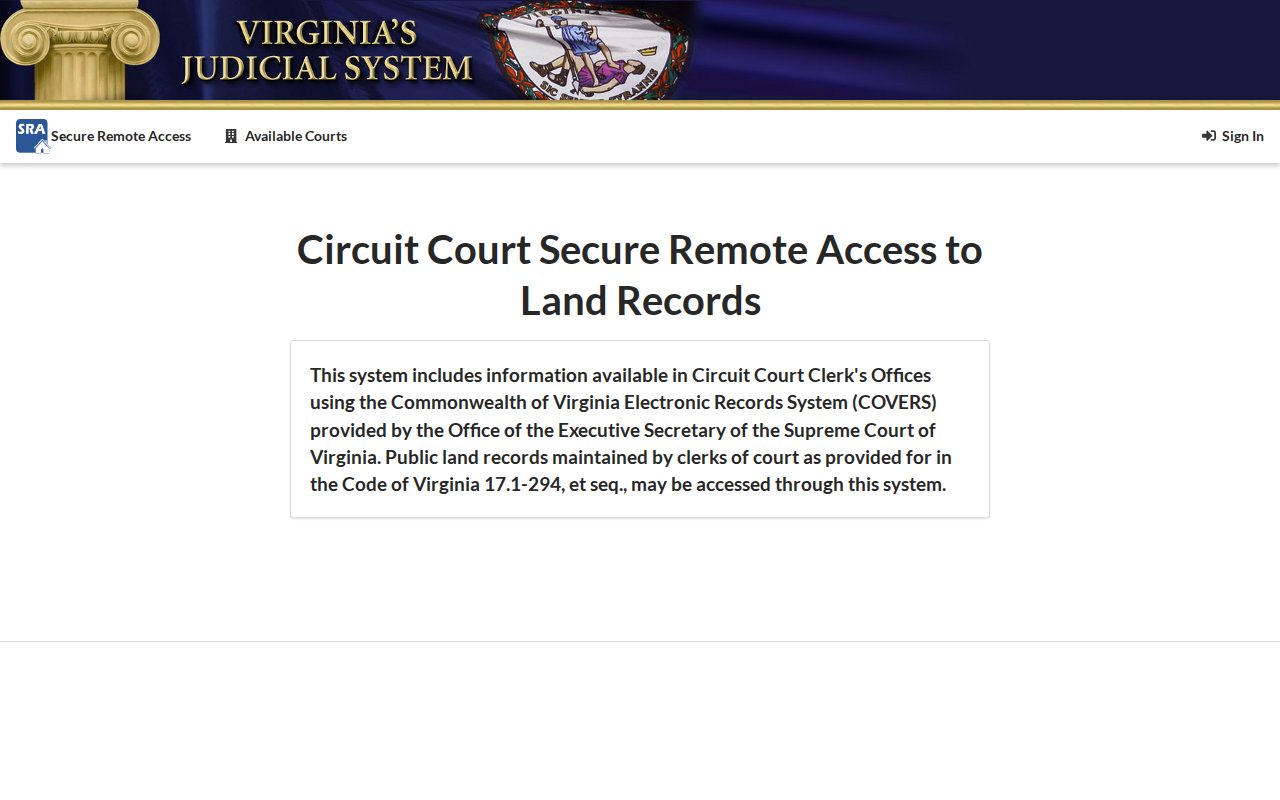
The statewide SRA page displays general access information. It shows no Prince George result and promises no local image.
Recorded Fees for Prince George Deed Documents
Virginia's statutory fee schedule frames recording and indexing charges. Those amounts differ from a remote image subscription price and from the Clerk's copy charge. Ask for the current total before sending payment, especially with a multi-page instrument or a large plat sheet.
| Recorded item | State fee framework | What to confirm |
|---|---|---|
| Instrument up to 10 pages | $18 for recording and indexing | Clerk's current total for the requested copy |
| Instrument 11 to 30 pages | $32 for recording and indexing | Whether other statutory charges apply |
| Instrument 31 pages or more | $52 for recording and indexing | Copy fee is separate from recording fee |
| Oversized plat or map sheet | $17 per sheet | Ask whether the sheet meets the statutory category |
| Remote subscriber access | Up to $50 per month and image fees within the statute | Local authorization and current SRA charges |
Virginia Code section 17.1-275 sets the fee schedule, and section 17.1-276 governs remote access to recorded instruments. Prince George publishes no local copy-price list or subscription image rate. Keep recording fees, copy charges and subscription costs separate when you compare options.
Prince George Historic Deed Books
Prince George County deed research reaches back through the Library of Virginia's catalog. It lists Book B covering 1710-1713, deeds from 1713-1728, and surviving books for 1759-1760 and 1787-1792. Later holdings include Deed Book 18 for 1842-1846, Book 22 for 1851-1854, and Book 24 for 1855-1858. General deed indexes span 1842-1953, along with an A-C segment for 1954-1976. The published description does not place the rest of the 1954-1976 letter coverage.
Older entries often name the parties' residences and describe land by adjoining owners or natural features. When a parcel has no modern street clue, hold onto creek, road, plantation, or neighboring-owner names while you search. The Library of Virginia's ARVAS deed-book finding aid describes surviving books and reel references. Archives Reference Services can be reached at archdesk@lva.virginia.gov or (804) 692-3888.
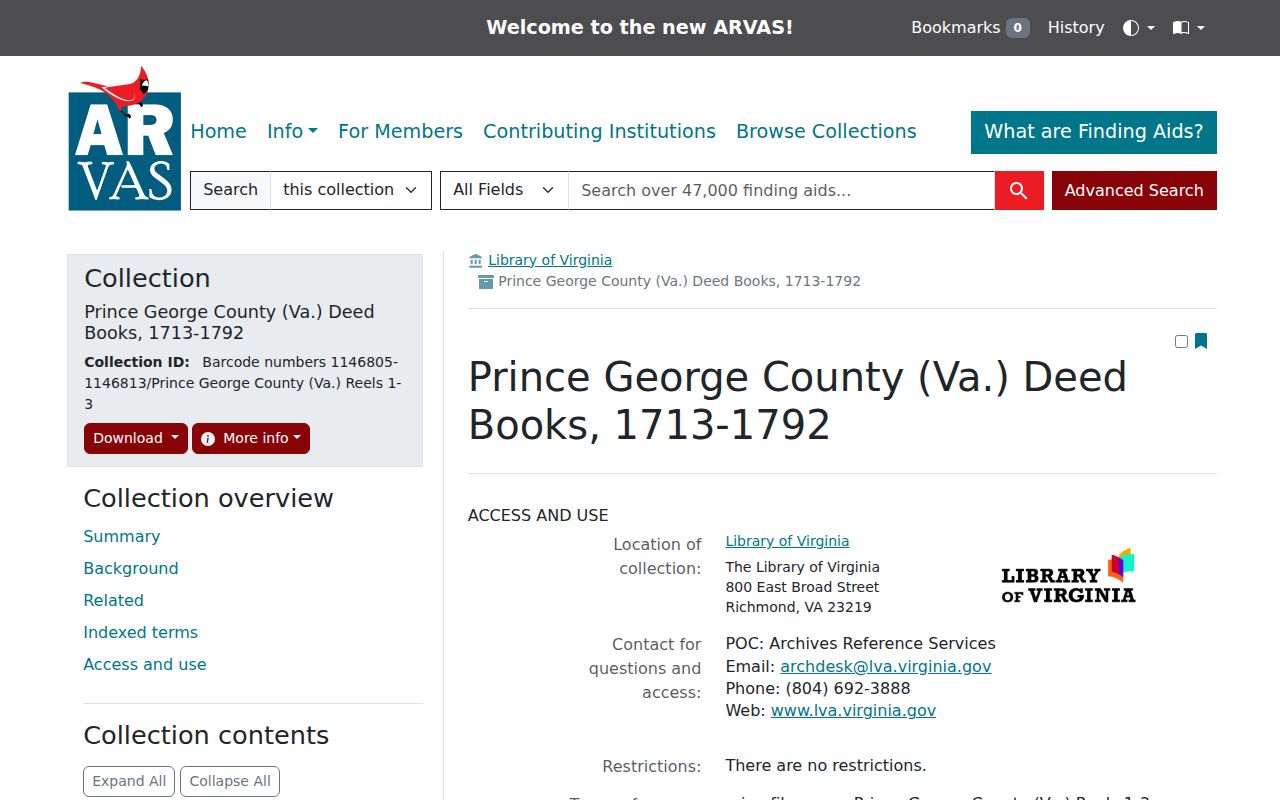
The finding aid describes archival holdings, not a full online deed search. Use the collection details to plan a microfilm order or an archive request.
Prince George Missing Deed Books and Lost Records
Some Prince George deed books simply do not exist anymore. Deed Books 25 and 26 are listed as missing. The losses run deeper than two volumes. British troops destroyed county records in 1782, and Union troops destroyed more in 1864. Because of those gaps, the surviving deed books cannot always document every transfer or prove an unbroken chain of title. When a link is absent, try name variants for the parties, an adjoining owner's name, probate and fiduciary material, chancery orders, and plat references. The Library of Virginia classifies Prince George as a Lost Records Locality.
Chancery records deserve special attention. Land often passed through an estate, a partition, or a dispute rather than a simple sale, and those cases can fill in what the deed books lost. The Prince George chancery finding aid covers causes from 1745-1956, with most listed records falling between 1869 and 1916. The Clerk or the archive can confirm whether a particular file exists. Treat the public listing as a starting point, though, not as a complete title record.
VADeed Alert for Prince George Filings
VADeed Alert is a free Virginia email notification system. It is linked from the Prince George County Circuit Court Clerk. You can enroll to watch a person's name or a business name. A Tax Map or Parcel ID works too. When a matching deed records, an alert arrives. That makes it useful for spotting a filing that deserves a closer look.
The system has clear limits. It does not stop a recording, validate a document, or replace the Clerk's official image. Save the alert. Then obtain the instrument. Compare its parties and legal description with the parcel. The official VADeed Alert enrollment page lists the available watch keys. It supports ongoing deed research once the right parcel is confirmed. A buyer, heir, or owner can make that confirmation first.
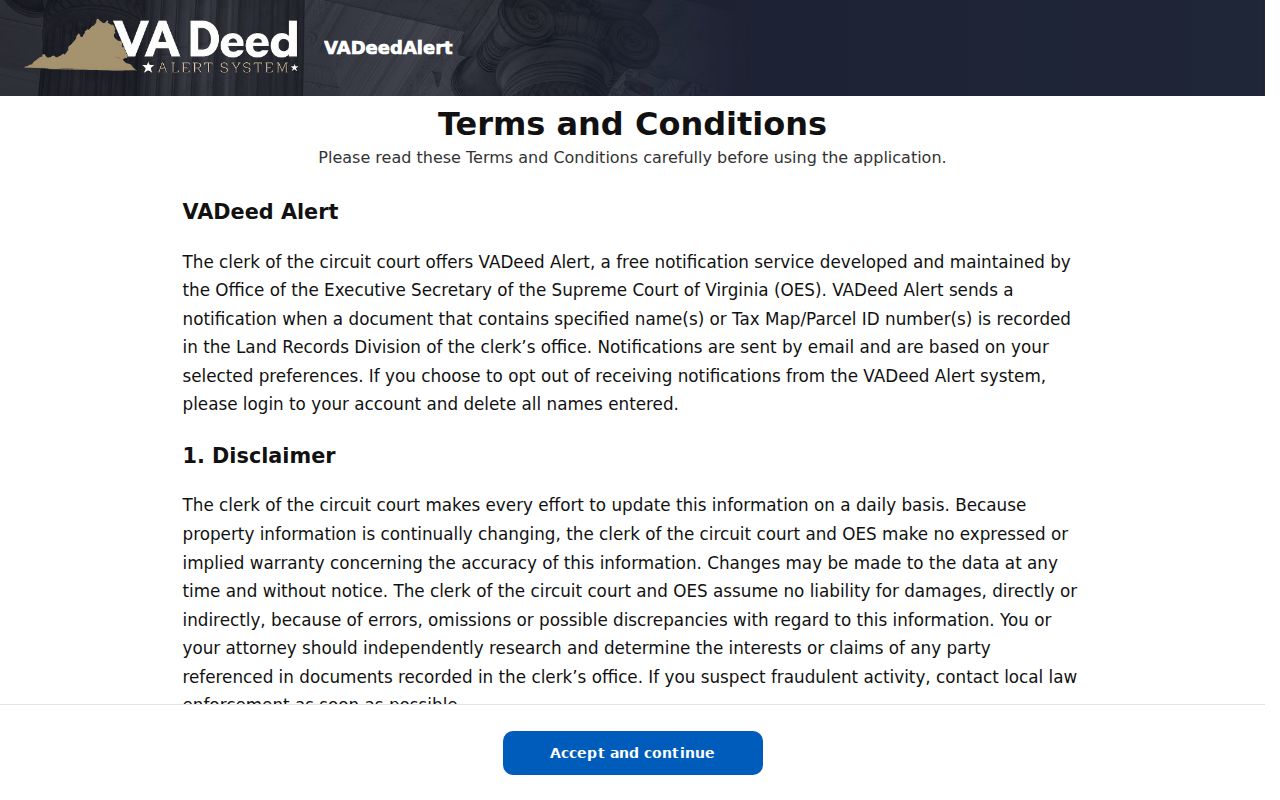
Treat the alert as a prompt to inspect a filing. It is not legal evidence that the filing is valid or harmful.