
The Current Owner Record in Prince George
The Real Estate Assessor's property record card is the public starting point. It anchors any search for the current owner of record. County budget material lists what it holds. Ownership, location, legal description, acreage and district all appear. Class code, source of title, sales date and sales amount do too. The public text does not show the live card's exact labels or update timestamp. So treat that inventory as documented card content. Verify recent transfers with the Circuit Court Clerk's recorded deed.
| Ownership record | Name carried by the assessor as owner of record |
|---|---|
| Location | Situs address and property location tied to the parcel |
| Mailing address | Destination for owner notices, which may be separate from the situs |
| Parcel description | Parcel ID, acreage, class, district and legal description |
| Source of title | Reference that may lead to the recorded deed |
| Sale fields | Sales date and amount described in county material |
The owner field has limits. It does not say who occupies a Prince George property, and a mailing address is a notice destination rather than proof of residence. Public records are not for targeting or pressuring anyone, so treat each field by its purpose.
Confirm the Prince George Grantee
Start with the newest deed. That record is the one to compare with the assessor's current owner field. A grantee is the recipient named in a transfer. It also names the grantor and legal description. Use the party names and document reference rather than relying on a sale amount alone. SRA image availability depends on the Circuit Clerk's local access settings, so the Clerk's counter remains a route when an image is not open online.
- Read the owner name and parcel information on Vision.
- Search the latest deed by the owner as grantee or by its recorded reference.
- Compare the deed's legal description with the assessor parcel and confirm any entity name exactly.
- Ask the Clerk for an in-person inspection or copy if SRA does not show the needed image.
- Owner of record
- The party named in the assessor field or the latest relevant deed.
- Grantee
- The person or entity receiving the interest in the instrument.
- Registered agent
- A company's public contact for legal process, not necessarily a property owner.
Contact a Prince George Property Owner
A mailing address can open a lawful door. A property card or tax record may list one. It can help with a boundary question or a notice tied to a purchase. It may belong to a trust, company, fiduciary or separate household. The county's public record does not establish that anyone lives at that address. Plenty of personal detail stays private. If a record looks wrong, the assessor's page links Factual Errors and Office Review information.
Lawful use. Keep owner contact tied to a legitimate property matter. Do not use the record to stalk, harass, threaten or harm anyone.
Prince George Situs and Mailing Fields
An owner-of-record search in Prince George County can return more than one address, and each serves a different purpose. Situs is where the property sits. Mailing is the destination for notices and tax bills. The county describes both property location and ownership as card content, though the public page does not show the live field labels. Mail going elsewhere changes no parcel.
Before a letter goes out, compare the situs address, acreage, legal description and parcel ID. Never treat a name as confirmed without that match. One mailing record may cover several parcels. A parcel record can go stale. For a stale one, contact the Real Estate Assessor through its official page instead of a third-party copy.
County budget material adds class code, district, source of title, sales date and sale amount to the card's details. These fields tie an owner name to a parcel and its recorded source. Labels can shift between systems. Ask the assessor how the live card presents those items. Do that before comparing a saved copy with a later deed.
Prince George's CAMA Ownership Mirror
Ownership on a Prince George property card comes from the Circuit Clerk's recorded documents. That is according to the FY2024 assessor report on the Computer Assisted Mass Appraisal database. Staff fold in deeds, easements, vacations, rights-of-way, splits, combinations, boundary adjustments, leaseholds, rezoning cases, and special-use permits. So the card paints a reliable picture of a parcel now. The deed still stands as the legal transfer record. A shift in land shape or use can change which card you should read.
The assessor swapped Proval for Vision. The FY2024 report notes Homebase electronic filing plus fillable forms. Those are assessment-system and filing upgrades. They do not set a digital start date for every deed image. The official assessor page links the public portal and county forms.
Find the office at 6602 Courts Drive, Suite 204, Prince George, VA 23875. Call (804) 722-8629 or email assessor@princegeorgecountyva.gov with questions about a card or a factual error.
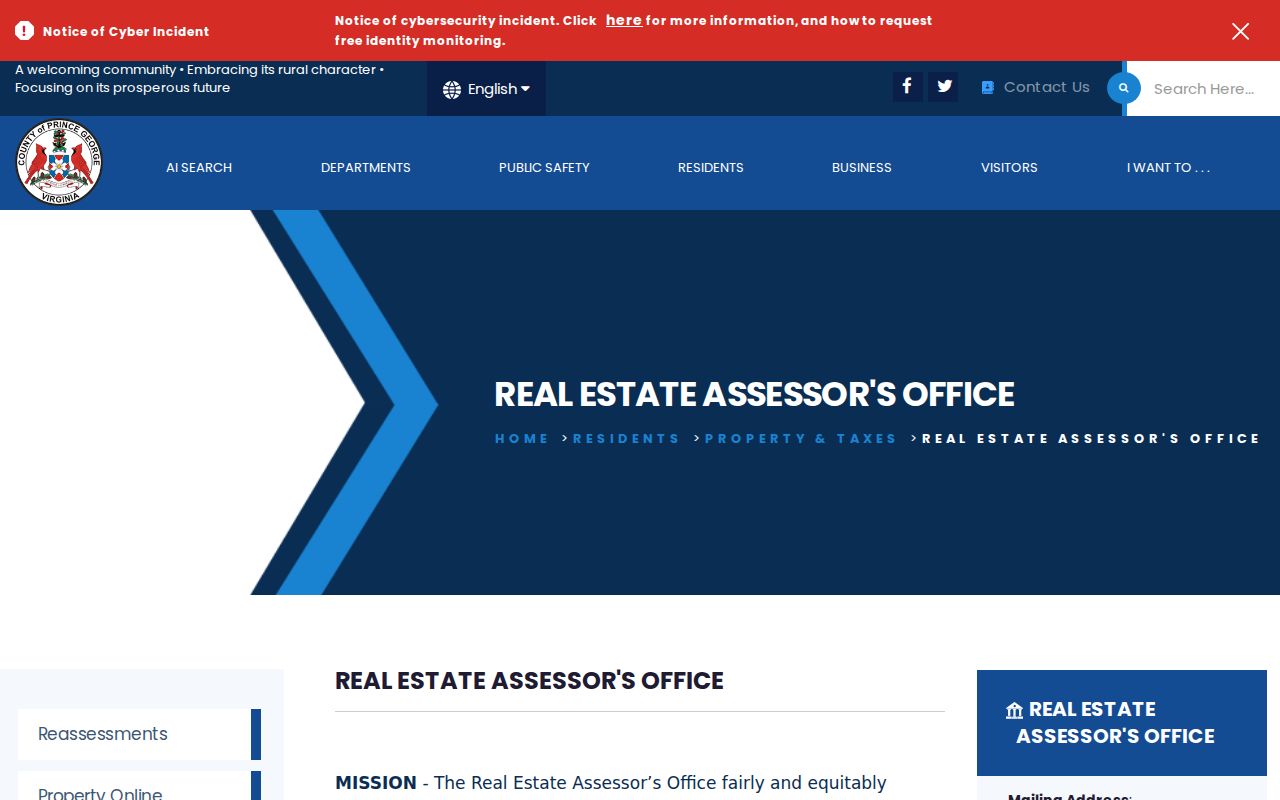
This is the assessor office page. It is not an individual parcel card, so confirm the live owner field and date with Vision or the assessor before relying on a recent change.
Confirm a Recent Prince George Transfer
A fresh closing shows up in two places at two speeds. Pull the newest recorded deed from the Clerk. Set its grantee beside the assessor's owner name. The assessor mirror may lag behind the recording. That gap alone proves nothing is broken. Note the grantee, grantor, recording date, legal description, and the instrument or book/page reference. If SRA offers no deed image, ask the Circuit Court Clerk to inspect the original. You can also order a copy.
The Prince George deed record route walks through the Clerk's index and copy requests. Need the full ownership chain? The who-owns method starts at an address and traces the parcel through every layer.
Entity Owners in Prince George
Prince George parcels are not always owned by a person. The owner of record may be an LLC. It may also be a corporation, a trustee, an estate, or another fiduciary. Read the grantee name on the deed exactly as filed. Then compare it against the assessor card. The Virginia State Corporation Commission identifies business names, status, and registered agents. Keep one caution in mind. A registered agent is only a legal contact for the entity. That role never proves the agent holds any interest in the real estate.
When the card still shows a decedent, the Clerk's Probate service and the estate papers can reveal who may act for the estate. Search the probate index under the fiduciary or estate name. Look for related recorded transfers too. An obituary or a company listing is not evidence of a title change.
The assessor card's source-of-title field can point to a recording reference. A reference is not the deed image itself. To prove a recent transfer, get the instrument from the Clerk. Then match its grantee to the card. Confirm any company's exact name separately before you rely on it.
Prince George Owner Record Timing
Prince George runs assessment on more than one clock. The assessor's public page describes a biennial reassessment program. The FY2024 annual report adds a January 1 valuation date each year and a July 1 effective date for the Land Book. The current Vision portal, meanwhile, advertises reassessment work for January 1, 2027. These are separate steps in one cycle. Record the assessment year and effective date printed with the owner record, and confirm current timing with the assessor before comparing cards from different years.
None of these dates govern when a deed becomes recorded. The Clerk's index and the assessor mirror can refresh on different schedules. The county publishes no fixed transfer-to-card lag, so check any recently changed owner against the newest recorded instrument.