
Prince George Property Value Types
Value fields describe different things. The assessor's record card carries assessment and sales fields. The deed documents the conveyance itself. The county's FY2024 report sets an annual January 1 valuation with a July 1 Land Book effective date, while the assessor's public page calls the reassessment program biennial. Keep the date shown with each assessment rather than flattening the calendar into one cycle.
| Value type | What it means | Where to look |
|---|---|---|
| Assessed value | Value assigned in the county assessment record for local purposes | Real Estate Assessor / Vision |
| Market context | Evidence about a likely sale value; not a captured appraisal field | Comparable sales and qualified valuation work |
| Recorded sale amount | Amount shown in assessor sale fields or transfer paperwork | Assessor card and recorded deed |
| Land and improvements | Separate components of the property assessment where shown | Assessor record; live labels not captured |
An assessed value is not a sale offer. It is not a licensed appraisal either. A sale closes on a set date. It may reflect condition, terms, or a partial interest. Prince George's assessor relies on a mass-appraisal process across property classes. Use the county review route for a tax dispute. For financing or a market question, turn to a qualified appraisal.
Look Up a Prince George Property Value
Vision advertises searches by Address, Owner Name, Parcel Number, and PID. The address works when you know the site. A deed or tax bill also supplies a parcel identifier. Save the parcel ID and the assessment date shown. The public landing page does not expose the live card's exact value labels, prior-year history, or update timestamp, so ask the assessor about any field that is not clear.
- Open the Prince George Vision database and choose the address, owner, parcel number or PID search.
- Confirm the parcel by location and legal description before reading the value field.
- Record the amount, assessment date and any land or improvement component displayed.
- Compare a sale field with the recorded deed and its recording date.
- Ask the assessor to explain a discrepancy or current reassessment notice.
- Assessed value
- The county's value entry for local assessment and tax records.
- Market value
- A likely sale value under current conditions, not automatically the assessor's number.
- Sale consideration
- The amount or terms stated in a transfer record.
- Assessment ratio
- A comparison of assessments with sale prices across a studied group.
What Prince George Assessed Value Cannot Say
The assessor's number is a tax assessment. It is not a promise of a buyer's price. It can differ from a later sale because the figures rest on different dates and methods. Prince George's annual report warns that permit dollars do not necessarily become added assessed value. Replacement work may add little. Partial assessments may already exist, so read the record as an assessment rather than a private appraisal of sale price.
Assessment versus price. A Prince George assessed value is for local assessment use and is not a sale appraisal. A transaction that needs a market opinion calls for a qualified appraisal.
Prince George Assessment Ratio Context
The FY2024 assessor report targets a 100 percent appraisal level. The acceptable range runs from 90 to 110 percent. A ratio compares an assessment with a later sale across a group of properties. It cannot say what one parcel would sell for. Prince George's example shows the math. A $100,000 assessment followed by a $110,000 sale yields a 90.9 percent ratio, while a $90,000 sale yields 111 percent.
Virginia's Department of Taxation publishes annual assessment-sales ratio studies for counties and cities. Each study covers one fiscal window. The 2022 study compared sales from July 1, 2021 through June 30, 2022 with July 1, 2021 assessments. Search results also carry 2023 Prince George median-ratio figures. Match them to the study table before drawing meaning.
The Virginia ratio-study archive provides the statewide context for Prince George property values.
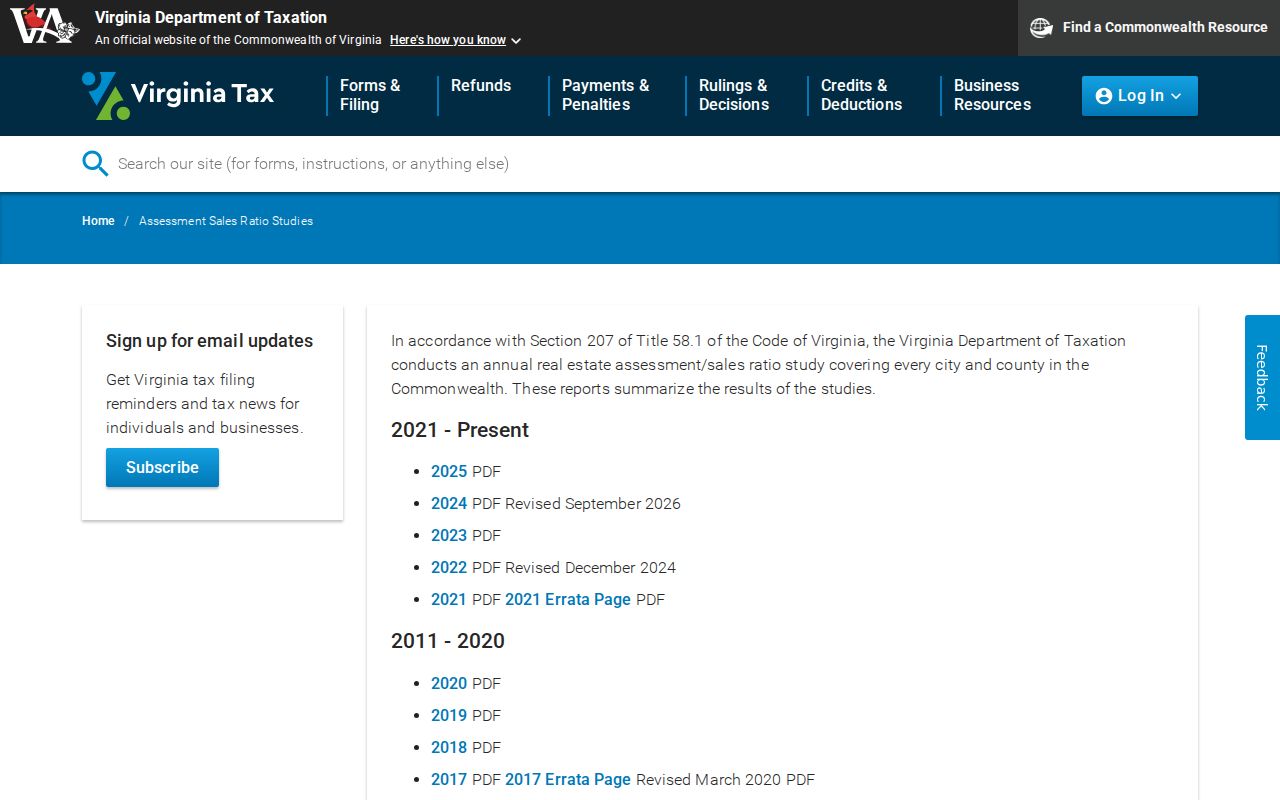
A ratio study tests assessment levels across sales. It is not a private appraisal of one Prince George property.
Prince George Reassessment Timing
Prince George reassessment runs on a biennial schedule, according to the assessor's public page. The FY2024 report values property each January 1. July 1 is the Land Book effective date. Vision's current landing page says a process will begin for January 1, 2027. Keep each date attached to its value. Never assume the tax roll and a new reassessment share one effective date.
The county report documents a system change. Prince George moved from Proval CAMA to Vision, with plans for Vision to handle fair-market-value work after its FY2024 land-use run. That history explains why a recent card may look different from an older Land Book reference. It does not fix the age of a value. Check the date on the current record. Ask the assessor for the active cycle.
The Real Estate Assessor is at 6602 Courts Drive, Suite 204, Prince George, VA 23875, reachable at (804) 722-8629 and assessor@princegeorgecountyva.gov. Contact the office when a value date or field on a card is unclear.
Prince George Sale Price and Assessment
A sale amount and assessed value differ. The assessor card described in county material includes a sales date and amount. The deed records the grantee, grantor, legal description, and transfer terms. Consideration language is evidence of a transaction. The assessor's field may summarize the sale differently. Confirm the instrument before comparing numbers, especially with multiple parcels, a partial interest, or a non-sale transfer.
A sale can close after the assessment date. It may involve work that changes the property's condition. An assessment can also reflect a countywide process rather than one negotiation between buyer and seller. For tax liability, relief, and appeal steps, use the Prince George property tax records page; a value comparison alone cannot calculate the current bill.
Prince George Residential Value Trend
Residential property dominates the Prince George roll. The FY2024 annual report puts it at 87 percent of all parcels. Those same parcels accounted for 42 percent of FY2023 Land Book value. Countywide, the mean residential value reached $252,570 for FY2024. That is a 9 percent rise over the $232,076 mean from the year before. Read these figures as broad measures of Prince George County property records trends. Never use them as a quote for one house. A mean tells you about the whole market, not your street. Keep the report year attached whenever you cite a number from it. That lets readers judge how fresh it is.
New construction also moved the total. Chappell Creek added newly finished homes to the July 1, 2023 Land Book. New structures and newly documented property together contributed $63.6 million of the increase. The report adds a caution. Permit values, it warns, do not automatically turn into assessment additions. Some permits cover replacement work or structures already partly assessed.
New Construction and Prince George Value
A building permit dollar figure is not added assessed value. That gap matters when you study Prince George County property records for one parcel. The FY2024 report explains why the two numbers can diverge. Replacement work may add little real value. A portion of a structure might already sit on the assessment card. It could date from an earlier year. For a single property, lay the assessment record beside the actual parcel details. Also check the valuation date before drawing any conclusion. Errors happen. If the card contains a factual mistake, the county assessor page links correction information.
The $63.6 million Land Book increase from new construction and newly documented structures is a countywide total. It describes no single building in Prince George. A buyer should treat it as evidence of how fresh construction entered the tax roll. It is not a cost estimate. It is not the market value of a new home either.
Land-Use Treatment and Prince George Value
Land-use assessment shifts the taxable treatment of eligible acreage in Prince George. The deed's legal description stays the same. So does the physical extent of the land. The FY2024 report lists four qualifying categories: agricultural, forestal, horticultural and open space. Participation is substantial. The report counts 1,345 parcels covering 93,316 acres. That is 52 percent of the county's land area. It makes land use a major feature of the local roll. Eligibility and the deferred amount for a particular parcel still need the assessor's confirmation.
Ending a qualifying use has consequences. The report says deferred taxes can be collected for the current year plus the previous five. This can happen through lack of production, rezoning or subdivision. Keep that tax question separate from value questions when reading Prince George County property records. Assessed value, market evidence and sale price are distinct ideas. On a specific assessment card, track land-use status apart from gross value. Track it apart from the Treasurer's bill, too.