
Prince George Property Search Steps
Vision is the practical first stop when you know a location or an owner in Prince George. Its landing page offers several ways in. Address, Owner Name, Parcel Number, and PID searches are all listed. So are Street Listing Search and Sales Search. The county does not state the exact match rules or the years covered. Treat a first result as a lead rather than an answer: note the identifier, the situs location, and the legal description, then carry those details to the deed, the map, or the tax account.
- Enter the known situs address, owner name, parcel number or PID in Vision.
- Confirm the result by comparing its location, owner name and legal description with the property clue.
- Save the parcel ID, acreage, source-of-title reference and sale fields shown on the property card.
- Carry the parties and recording reference to Virginia SRA or the Circuit Court Clerk for the deed.
- Use the Treasurer and GIS for their separate tax-account and map questions.
Prince George Property Search Fields in Vision
The public landing page shows only a short menu. It names four search keys and two extra modes. The inner result form stays out of view. That leaves real gaps, since required fields, partial-match behavior, sorting, and result limits all go unstated. A failed query can simply mean odd formatting or thin coverage, not a missing parcel. Switch to another listed key, and call the assessor before reading a null result as proof that the property does not exist.
| Portal label | Type | Use | What remains unverified |
|---|---|---|---|
| Address | Text search | Find a known situs location | Required format and partial matching |
| Owner Name | Text search | Find a named owner or entity | Name order and match rules |
| Parcel Number | Text search | Open a known parcel record | Punctuation and exact format |
| PID | Text search | Use the public identifier | Format and relationship to parcel number |
| Street Listing Search | Search mode | List properties by street | Inner fields and result limits |
| Sales Search | Search mode | Review assessor sale data | Filters, date range and coverage |
The Vision property-information landing page displays the search modes the county makes public. Start there for any online search.
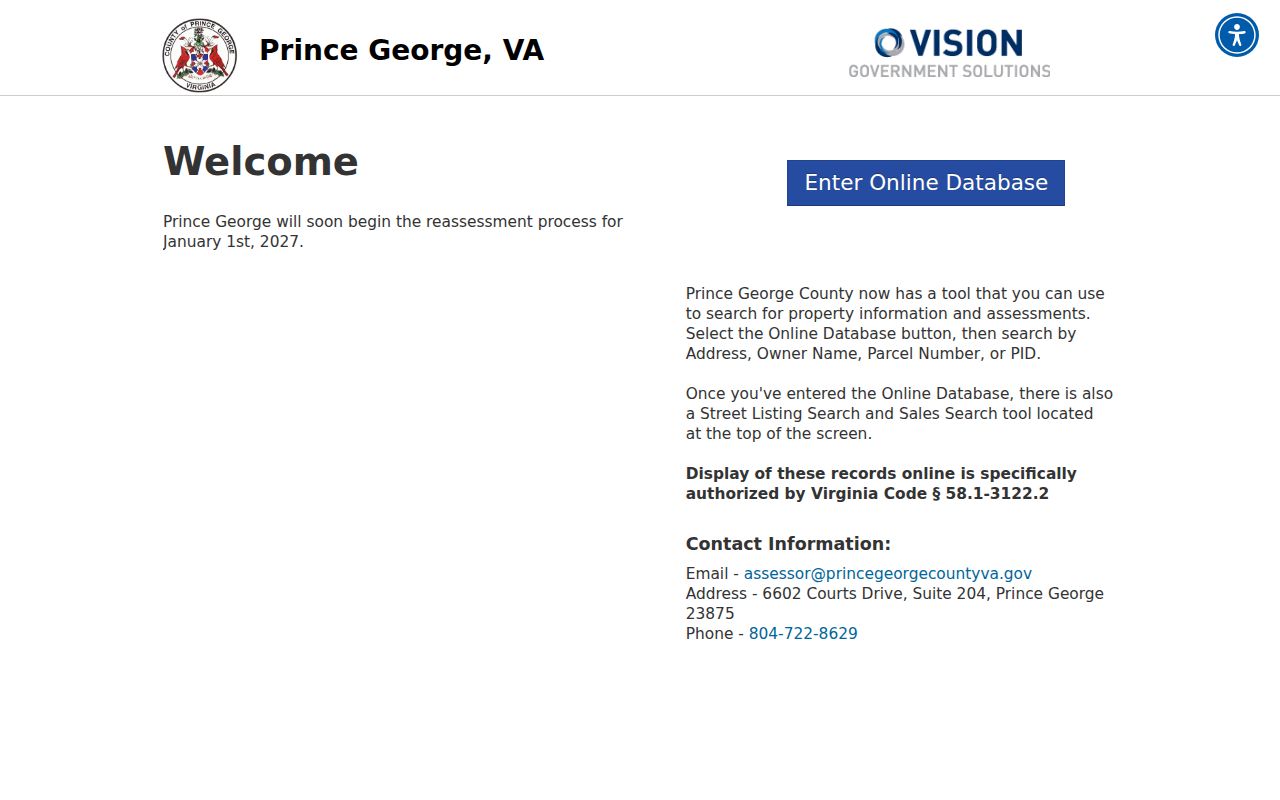
Only the landing instructions appear in this view. Check the live portal before relying on an exact field name or result format.
What the Prince George Property Search Result Shows
County budget material describes the property record card in detail. Its fields are extensive. The card carries an ownership record, legal description, acreage, class code, district, and source of title. Property location appears too. So do sales date and sales amount. Vision is built to mirror ownership from recorded documents. Even so, the card is a working set of fields rather than a guarantee, because the public text does not publish the live labels, update timestamps, or any online deed image.
| Ownership record | Name carried on the assessor roll; verify the newest deed for a transfer |
|---|---|
| Location and mailing | Property situs and owner mailing destination are distinct fields |
| Parcel number or PID | Cross-reference for assessor and GIS research; exact format not published |
| Class, district and acreage | Property attributes described in county budget material |
| Source of title | Recorded-document reference that can help locate the deed |
| Sales date and amount | Assessor sale fields; compare with the recorded instrument |
A property search has firm limits. It will not surface every unrecorded agreement or prove a lien has been released. It cannot settle a legal boundary either. A newly recorded deed may not show right away. The assessor updates its ownership mirror over time. For hard answers, go to the sources. Use the current deed for transfer evidence. The Treasurer can confirm the current tax account. A licensed surveyor handles any boundary dispute. If a field looks missing, ask the Assessor what the public card contains. Do not guess from another county's portal.
The online entry point stays the same. Open the Prince George property database to check the current route to a card.
This view shows no sample parcel card. Confirm the live result's full labels, update time, and history fields with the assessor.
Choose a Key for Prince George Property Search
The best key depends on what you know and what you need to confirm. Address works well for a single site. Owner Name suits a hunt across someone's holdings. Names repeat, though, and they change. Parcel Number and PID win when a bill, map, or prior record already carries an identifier. Use the legal description as a second check, especially where a split or combination has reshaped the roll.
| Search clue | Use it when | Verified Prince George route | Check next |
|---|---|---|---|
| Address | The property location is known | Vision Address search and county map products | Confirm the legal description and parcel ID |
| Owner Name | The person or entity name is known | Vision Owner Name search; deed index by parties | Check address, acreage and entity spelling |
| Parcel Number or PID | A tax, map or deed reference is known | Vision and VADeed Alert use parcel identifiers | Keep predecessor and successor IDs after a split |
Not a title search. A Prince George property search points to public records; it does not confirm marketable title, a released lien or an exact boundary. A title professional reviews the full record chain.
Prince George Street and Sales Searches
Street Listing Search earns its keep when you need every parcel along a road instead of one address at a time. The portal names this mode plainly. It hides its fields and columns. Treat its output as a starting list. It can support a block-level inventory, but it is not a GIS selection and not a complete neighborhood list; verify each parcel through its property card.
Sales Search also sits atop Vision. The portal does not describe its filters, its years, or how it treats transfers. A sale field on the assessor card is context only. The recorded deed remains the evidence. It settles the instrument, the parties, and the consideration language. Save the date and parcel ID from any result, compare them with the recording reference, and remember that not every transfer reflects an arm's-length sale.
An owner search can return an individual, a company, a trust, or an estate, exactly as the roll carries the name. Names mislead. Try the legal name and a reasonable spelling variant when a known parcel fails to appear, then compare the situs address and legal description before calling it a match. A business-tax account is not ownership proof. Neither is a registered-agent entry; the deed names the grantee and confirms the transfer.
For the county's official search labels, use the Vision entry point. Still stuck? Call the Assessor at (804) 722-8629. The office can confirm whether a road or sales search exposes the field you need.
Prince George Situs and Mailing Clues
A situs address marks where the land actually sits. The mailing address is different. It shows where the owner of record gets assessment notices and tax bills. Owners often live elsewhere. Some hold several parcels. Others title land to an entity. A few route bills to a business office. That is why a mailing label should never be mistaken for the property's location. If a Prince George result looks off, compare its map position, legal description, acreage and parcel number. Then pull the underlying deed or ask the assessor which address field the search relied on.
- Situs address
- The street location tied to the parcel.
- Mailing address
- The address used to send owner notices or bills.
- Owner of record
- The name carried in the assessor's ownership field.
- Legal description
- The written land description in the recorded instrument.
Prince George is a census-designated place, not an incorporated city. No city assessor or recorder exists there. County offices handle every property records request, no matter how local the mailing label looks.
Prince George Parcel Changes
The assessor's report counts vacations, easements, rights-of-way, boundary adjustments, splits, combinations, leaseholds, rezoning and special-use permits among the parcel changes. Staff process these. A Prince George parcel number can change after a split or merger. The old number may no longer lead to the current card. Keep the old identifier beside the new one and compare acreage, boundary calls and the source-of-title reference. Prince George publishes no confirmed public description of its PID format. So treat any prefix or digit pattern from another county as a guess rather than a rule.
Sometimes the assessor, the GIS map and the deed index seem to describe different parcels. When that happens, follow the legal description and the recorded plat. The assessor can explain predecessor and successor account references on a parcel. The Clerk can locate the transfer or boundary-line instrument behind the change. Land that has been reconfigured takes more than a street address to pin down. A complete parcel lookup leans on the deed records and the plat.
A short search log pays off. Note the date. Note the Vision mode, the address or owner spelling, the parcel ID and the result reference. For a deed result, record the parties, the recording date, the book/page or instrument number and the legal description. That log makes it easy to compare a later assessor card with the same instrument. It also helps office staff see at once which result was missing or unclear.
Prince George Property Search Limits and Help
Some limits are easy to hit. The online public page does not state the earliest card year or the exact field labels. Nor does it give the update schedule or how deep the history goes. The Treasurer page exposes no tax-account search endpoint. For deed images, SRA says access depends on the local clerk. It may also require an authorized subscription. These gaps are verified facts, not proof that a record is missing. Ask narrowly, and name the parcel, party, instrument or date span you need.
The Real Estate Assessor sits at 6602 Courts Drive, Suite 204, Prince George, VA 23875. Call (804) 722-8629 or write assessor@princegeorgecountyva.gov. Weekday hours run 8:30 a.m. to 5 p.m. A Virginia FOIA request can arrive by mail, fax, email, in person or phone. It must identify existing records with reasonable specificity. The county does not have to build a new database. Nor must it answer an open-ended research question.
Deed questions go to the Circuit Court Clerk at 6601 Courts Drive. The clerk asks that filings and financial transactions be complete before 4:15 p.m. The Treasurer and the assessor share the 6602 Courts Drive complex but keep separate files. Contact whichever office owns the search result. No single desk can correct every record tied to a Prince George parcel.
Search is not title. A Prince George property search is a way to find records. It does not guarantee clear title, a released lien, a current tax balance or a surveyed boundary.